Growing up in Dallas, Texas, Chance’s passion started where it does for many enthusiasts: behind a video game controller, playing Need for Speed: Most Wanted. Even today, the original game’s soundtrack remains a daily part of his Spotify rotation.
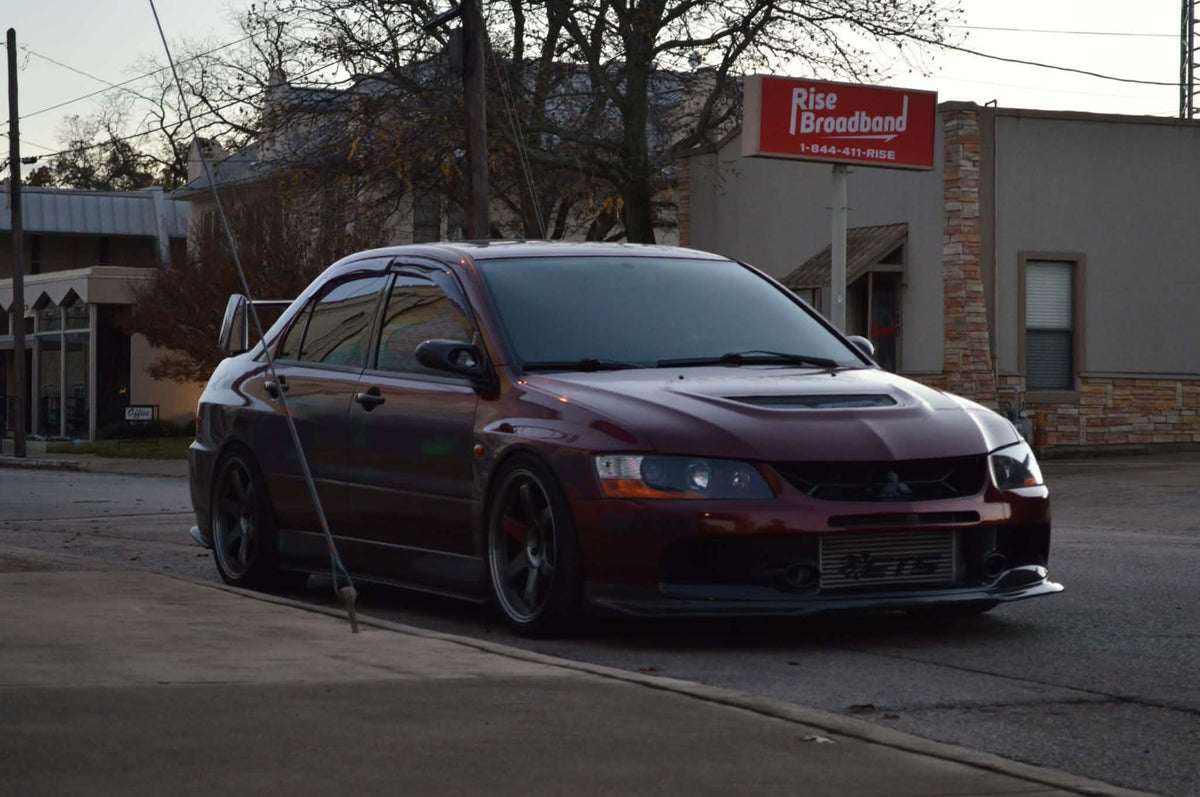
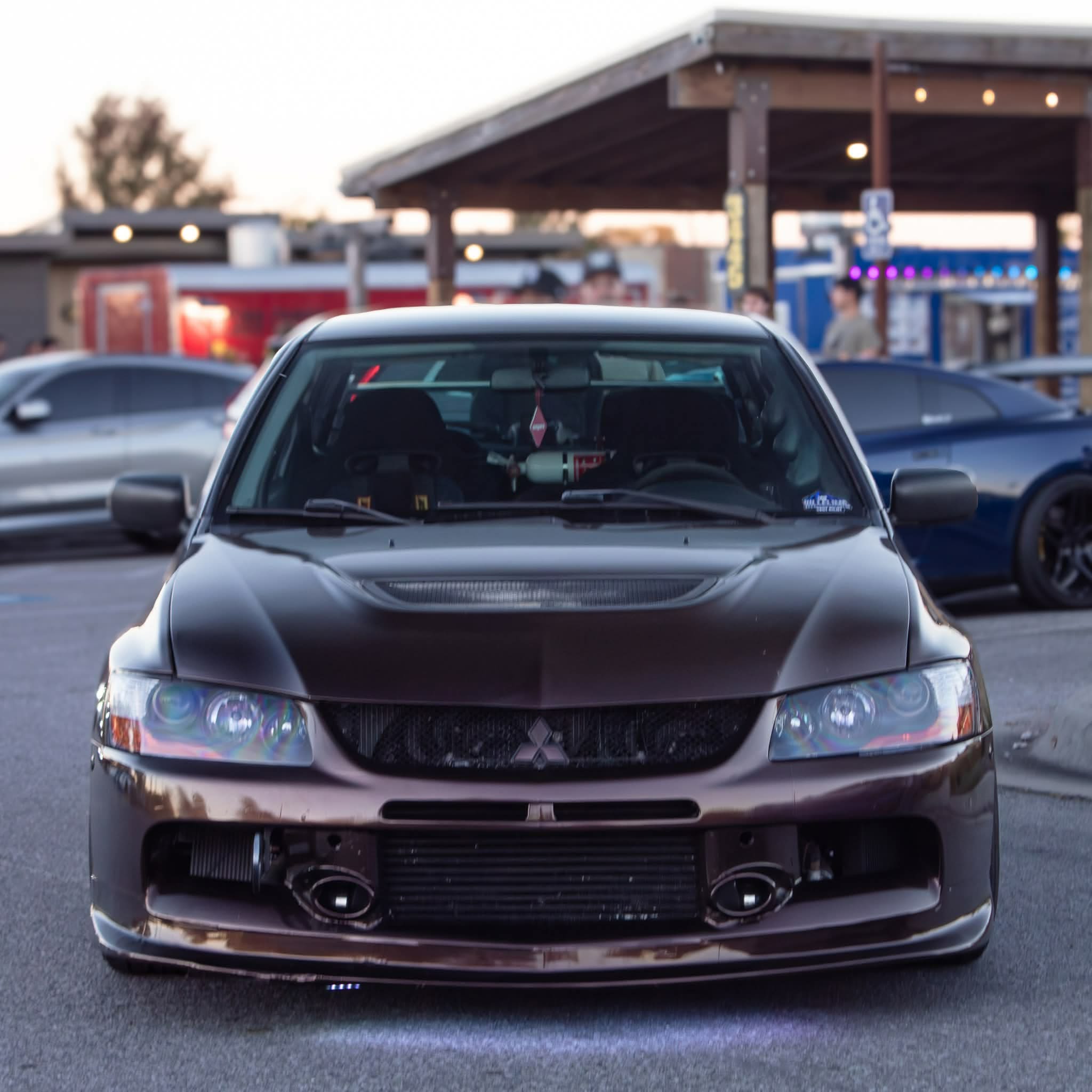
That childhood obsession eventually turned into a real-world passion for building cars, and today Chance is the owner of an incredibly clean 2015 Mitsubishi Evo X GSR making more than 700 wheel horsepower while retaining the refined, OEM+ character he always wanted.

From a High School Accord to the Evo Life
Chance’s first taste of modifying cars came during high school with a 1998 Honda Accord. He added underglow, picked up a set of wheels from Facebook, and spent his free time tinkering with the car.
After moving to Dallas in 2014, everything changed.
Chance became much more involved in the local car scene and built a turbo K20-powered Civic. Shortly after completing that project, however, he sold it and entered the Mitsubishi Evo world—a platform that has remained a major part of his life ever since.
The current Evo X is actually the fourth Evo Chance has owned.
He purchased the 2015 GSR from his friend Michael, drawn to its extremely low mileage and relatively clean condition. There was also some history behind the car: Chance had previously helped his friend Justin put the Evo together when it was still running a basic FBO E85 setup.
Four years later, the car has evolved into something completely different.
The Goal: 700 WHP Without Losing the Evo
From the beginning, Chance had a very specific vision for the build.
Ten years ago, shortly after moving to Dallas, he met his friend Justin, who owned a 2014 Cosmic Blue Evo X making around 400 wheel horsepower. Chance remembers riding in that car and immediately falling in love with the platform.
From that moment, he had a goal: build a 700-whp Evo X.
But horsepower alone wasn't the objective.
Chance wanted an OEM+ street car—something that could make serious power without looking like a stereotypical high-horsepower build. The engine bay needed to remain relatively stock-looking, the exterior needed to stay clean, and the interior needed to avoid being overwhelmed by aftermarket gauges.
Judging by the finished product, that vision came together remarkably well.
A 700+ WHP 2.0-Liter Powerhouse
The entire current build was completed by Kozmic Motorsports, after Chance decided that the scope of the project had grown beyond what he realistically had time to tackle himself.
Under the hood is a built 2.0-liter engine featuring:
- Manley rods and pistons
- ACL bearings
- Kelford 214B cams
- ARP 625 head studs
- ARP main studs
- Magnus exhaust MIVEC delete
- AGT 64mm dual-ball-bearing single-scroll turbo
- Full-Race tubular manifold
- ETS open-dump downpipe
- Tomei cat-back exhaust
Fuel delivery is handled by dual Walbro 450 pumps, FIC 2150cc injectors, an -8 feed line, -6 return line, and a Fuelab fuel-pressure regulator.
The result is an Evo producing just over 700 wheel horsepower and 570 lb-ft of torque on a Mustang dyno.
There was still some power left on the table, but the team decided to stop pushing once exhaust backpressure began reaching levels they weren't comfortable with. For Chance, making a number isn't worth sacrificing the reliability and drivability of the car.

Built to Put the Power Down
A 700-whp Evo needs more than a built engine and turbo.
Chance's GSR features a built transmission with a 4.30 final drive and PPG short fifth gear, paired with an OSGiken twin-disc clutch.
Suspension duties are handled by Öhlins coilovers, Whiteline rear control arms, and Whiteline sway bars.
The car rides on 18x10.5 +15 Enkei RPF1s finished in SBC, wrapped in Michelin Pilot Sport 4S tires measuring 275/35/18.
Visually, the setup is aggressive without being excessive—a perfect match for Chance's OEM+ philosophy.
A Seibon carbon-fiber trunk adds another subtle performance-inspired touch, but otherwise, the exterior remains remarkably understated.
The Dashboard That Keeps the Interior Clean
One of the most interesting aspects of the build is the digital UC10 dash.
According to Chance, his may have been the first in the country to have every OEM feature fully integrated and operational.
The motivation behind the conversion wasn't simply to make the interior look more modern. It was actually about keeping the cabin cleaner.
Rather than filling the dashboard with aftermarket gauges for oil pressure, fuel pressure, coolant pressure, oil temperature, and other critical information, the UC10 system allows Chance to monitor the car while maintaining the factory-like appearance he wanted.
The rest of the interior remains essentially stock, with the exception of the digital dash and an iDoing head unit for Apple CarPlay.
It's a small detail that perfectly represents the philosophy behind the entire car: high performance without visual clutter.

A Haltech Brain Watching Everything
Managing the Evo's substantial power is a Haltech Nexus S2 ECU, equipped with an extensive collection of safety features and sensors.
The car monitors:
- Exhaust backpressure
- Coolant pressure
- Fuel pressure
- Oil pressure
- Oil temperature
- Boost
- Other critical engine parameters
The system also incorporates rolling anti-lag, boost-by-gear, wireless data logging and tuning, and adjustable boost maps that can be changed on the fly using the AYC control button.
David at Kozmic and Mike from M-Tuned work together on the tuning sessions, with a major goal of the project being to explore just how far the newer AGT stock-frame turbo technology could be pushed.
Breaking the 700-whp mark while maintaining relatively manageable backpressure was a significant achievement.
More Than a Dyno Queen
Despite the car's 700-plus-wheel-horsepower output, Chance isn't particularly interested in launching the Evo down a drag strip.
He prefers roll racing.
The Evo is currently capable of a low-five-second 60–130 mph, making it an extremely serious street performance machine.
But perhaps the most impressive part isn't the acceleration. It's the way the car behaves when you're not driving it hard.
Chance describes the Evo as driving almost like a stock car.
That's exactly what he wanted.
“I just love the way it drives as it drives like a stock car.”
For a car with more than 700 wheel horsepower, that's quite an accomplishment.
The Hard Lessons Behind the Build
Getting to this point wasn't easy.
Chance has built his previous three Evos himself, but his workload eventually made it necessary to turn the current project over to a professional shop.
Before Kozmic Motorsports took over the build, Chance had an extremely frustrating experience with another shop in Oklahoma City. He spent approximately $25,000, only to have the car suffer catastrophic failures within 900 miles—twice.
The experience reinforced one of the biggest lessons he's learned throughout his years in the car scene:
Do it right the first time.
Chance estimates that trying to save money by taking shortcuts has ultimately cost him hundreds of thousands of dollars across his various builds.
His experience with Kozmic has been dramatically different.
The team completely redid the car, and Chance says it has been almost perfect aside from a few minor setbacks that were nobody's fault.
More importantly, he appreciates that David and the Kozmic team have consistently looked out for his best interests rather than simply chasing bigger numbers.
The Car That Built Friendships
For Chance, the Evo represents much more than horsepower, parts and dyno sheets.
These cars have given him some of his closest friendships and favorite memories.
One of his closest friends, Cody, owns a Kozmic-built Evo 8, and Chance considers him a brother. The two are constantly discussing their next modifications and how they can continue chasing the horsepower figures they've wanted since meeting seven years ago.
One of Chance's favorite memories with the current Evo happened during TX2K22.
At the time, the car was still running the stock turbo on E85 and making around 400 wheel horsepower. Chance, Cody and Chance's girlfriend Chelsea drove to Houston for the event, with Cody bringing his ZL1 1LE and Chelsea bringing her SS.
They stayed for the entire week.
The car wasn't anywhere near its current power level, but that didn't matter.
For Chance, the trip was about the people, the cars and the memories—and it's something he'll never forget.
Even today, some of his favorite drives are much simpler: taking the Evo out for a random date night with his girlfriend.
Why Octane Blue?
Chance's Evo wears its factory Octane Blue paint, a color he considers one of the best available on an Evo X.
He's also not a huge fan of most wrap jobs, preferring instead to preserve the original paint.
That philosophy extends to the rest of the exterior.
Rather than turning the Evo into an exaggerated show car, Chance has focused on keeping everything clean and cohesive. The aggressive hardware is there, but it doesn't scream for attention.

What's Next? 900 WHP
For most enthusiasts, 700 wheel horsepower would be the finish line.
For Chance, it's another milestone.
The Evo is scheduled to return to Kozmic early next year for an even more ambitious combination. The current turbo setup will make way for a top-mount turbo kit with a 6870 NexGen, while the transmission will be upgraded to a DogBox.
The ultimate goal?
900 wheel horsepower on a Mustang dyno.
Despite that massive target, Chance doesn't plan on abandoning the principles that made the current car special.
He wants the Evo to become the ultimate street weapon while maintaining the OEM+ characteristics that make it so enjoyable to drive.
Eventually, he'd also like to take the car to FL2K and compete in the roll-racing event.
More Than a Car
After four years with this particular Evo—and more than a decade of Evo ownership—Chance's relationship with the platform goes far beyond modification.
The cars have given him friendships, memories, experiences and a community that has become a major part of his life.
And his 2015 Evo X GSR represents the culmination of everything he's learned along the way.
It's powerful without being obnoxious. Clean without being boring. Comfortable enough to drive to work, yet capable of running a low-five-second 60–130.
Most importantly, it proves that an Evo doesn't need to sacrifice its character to become brutally fast.